
Talabat, Deliveroo and Careem commission: is your restaurant paid what it is owed?
Dinelax POS · 7 min read · Updated 17 October 2026
Every week each delivery app pays you one number. Behind it sit dozens of orders, a commission, fees and refunds. Here is how to check that number against your own orders — and catch the money that never arrives.
What comes off a delivery order
Your contract and the partner's statement list which of these apply to you:
- Commission — a percentage of the order value. Rates differ by partner and by contract.
- Discounts you fund — a promotion the partner runs at your expense comes off your side, not theirs.
- Marketing and listing fees — sponsored placement, ads or a weekly subscription.
- Per-order or delivery charges — when the partner's riders deliver for you.
- VAT on the partner's fees — if the partner charges VAT on its commission and fees, it appears on its tax invoice to you.
- Refunds and cancellations — orders refunded to the customer and charged back to you.
For a sense of scale: a First Abu Dhabi Bank research note put talabat's average commission in the first quarter of 2025 at about 14–15% overall and 17–18% for restaurants, across all its markets (FAB research). Your own rate is the one in your contract — use that.
A weekly check, worked through
An example with round numbers. Put your own contract rate and fees in their place.
| Orders this week (from your POS) | 100 orders · AED 6,000.00 |
| Commission at your contract rate (example: 25%) | − AED 1,500.00 |
| Marketing fee on the statement | − AED 200.00 |
| VAT 5% on commission and fee | − AED 85.00 |
| What the partner should pay | AED 4,215.00 |
| What reached your bank | AED 4,050.00 |
| Variance to raise with the partner | AED 165.00 |
The variance is the part worth chasing. Common causes: an order refunded that the kitchen actually sent, an order missing from the statement, a price on the app that no longer matches your menu, or a fee you never agreed to.
Why your POS has to hold the other half
The partner's statement is their record. To check it you need your own: every partner order, with the partner's order number, at the price you charged on that app. Without it, the only number you have is the one they paid you.
How Dinelax keeps that record
- The cashier rings in each Talabat, Deliveroo, Careem or Noon order at the counter with the partner's order number. (Orders are entered by hand today; they are not imported from the apps automatically.)
- Each partner can have its own menu price, so a dish can cost more on an app than at the counter.
- VAT can be inclusive or added on top, set separately for each partner.
- Partner orders count in your sales but never in the cash drawer, so the shift still balances.
- You save each partner's commission % and its extra charges — marketing fees, per-order charges, VAT on the commission, weekly subscriptions.
- The weekly Online Settlements screen then shows, per partner: orders, gross, commission, what the partner owes, what actually landed in your bank, and the variance.
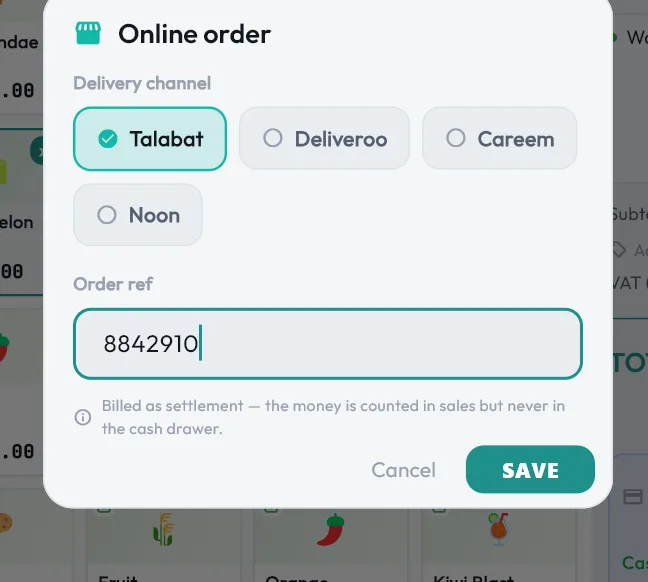
A five-minute weekly routine
- Open each partner's weekly statement.
- Enter what reached the bank against that partner's week.
- Look only at partners with a variance.
- Match their order list against your POS orders by order number.
- Raise the difference with the partner, with the order numbers.